
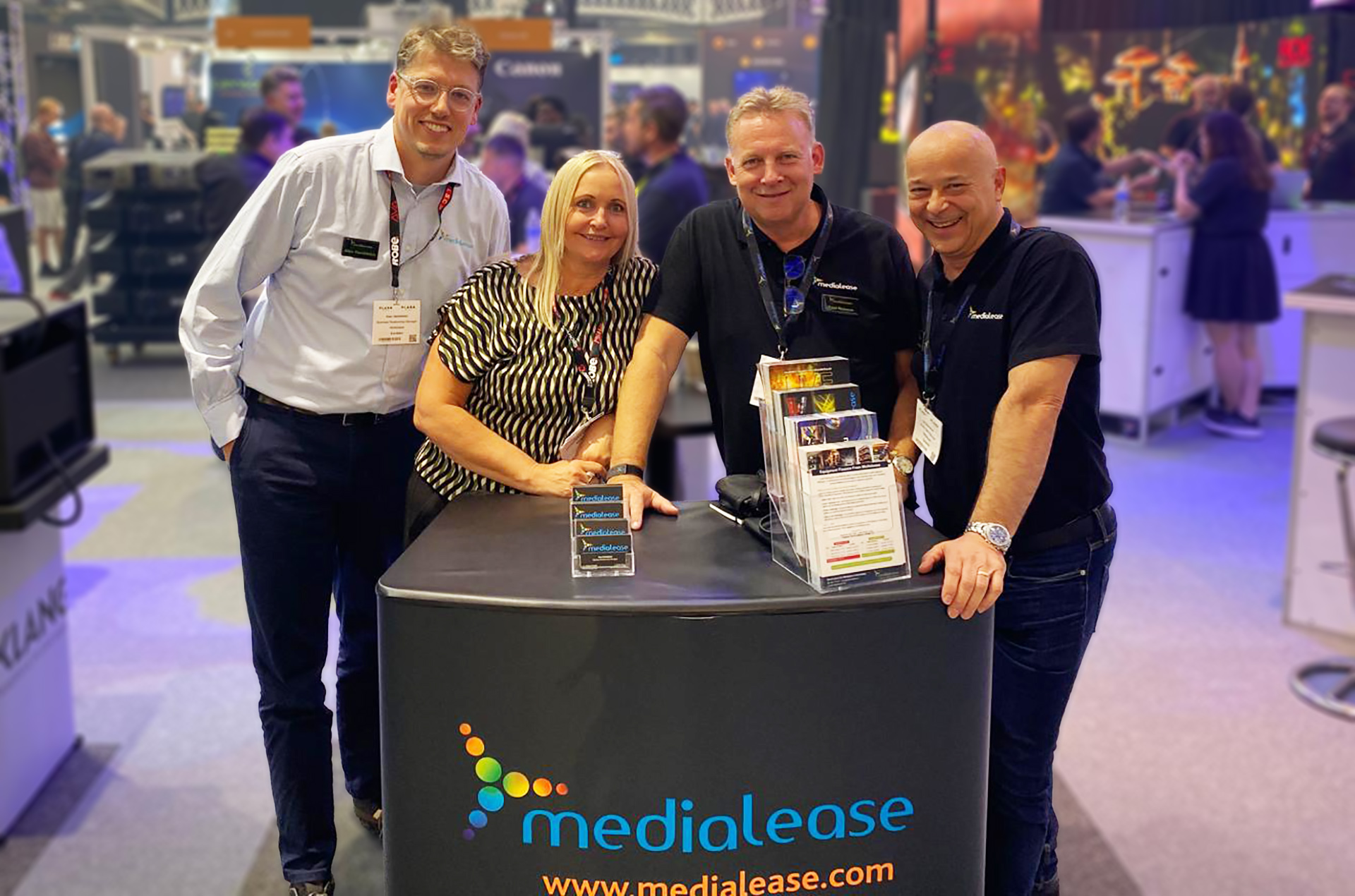
Paul Robson, Managing Director, Medialease, looks at why international broadcast and AV exhibitions are facing an identity crisis
The trade show calendar used to be predictable. NAB in spring, PLASA and IBC in autumn, and ISE in winter. Three fixed points that the broadcast, AV, and events industries built their year around. That predictability is breaking down, and the reasons are as much geopolitical and structural as they are about shrinking floor space.
NAB’s National Problem
NAB has always billed itself as the North American show, but word from the floor is that visitors from Mexico and Canada are increasingly reluctant to travel to Las Vegas. That’s nothing to do with the chips. More to do with Top Trumps! This is a shift that, err… chips away at the very premise of the event.
Since 1999, I’ve been a regular attendee at NAB, along with many hundreds of my broadcast industry friends and work associates. However, this show has slowly been eroding the UK visitor’s wallet, and, as far as the UK audience are concerned, since Covid it’s been a show for North Americans only – the Piano bar is no longer buzzing with Oasis singalongs! A show that markets itself on continental reach can’t afford to lose two-thirds of the continent’s engagement. If that trend continues, NAB may need to rethink not just its content but also its geography.
IBC
IBC’s numbers were down again this year. IBC quoted 41,000 visitors for this year, down 2k from 2025 levels and more than 12,000 down since pre-Covid times! That’s not news to anyone who walked the halls this year.
And yet, across the exhibition, 256 companies made their IBC stand debuts; that’s an increase of 26% from 2025, while the show’s big tenants such as Grass Valley, Avid, Sony, and Blackmagic continue to have enormous stands, making a huge statement. That’s the paradox of IBC right now: a show that is visibly contracting in attendance, while its biggest players double down.
The question worth asking is whether IBC actually needs to operate at its old scale to remain relevant. Technology has moved on since the show was launched almost 60 years ago. The broadcast, production, and IT industries have blurred, with the AV spectrum looking at broadcast quality levels, converging with yet more industry sectors. What used to require a dedicated show now lives inside adjacent ecosystems. IBC’s real challenge isn’t size; it’s identity. What is IBC for, now that “broadcast technology” isn’t a clean, separate category anymore?
That identity question is inseparable from a looming practical one: IBC’s contract with Amsterdam’s RAI venue runs out in a couple of years. Renewal is not guaranteed, and there are persistent rumours that RAI real estate could be redeveloped away from a trade show space. IBC in 2030 is genuinely an open question, asking not just which city but whether the show exists in its current form at all.
ISE’s Expansion
Meanwhile, ISE continues to grow, and it isn’t shy about luring the broadcast sector into what is already one of the largest trade shows in the world. That raises an uncomfortable but obvious question: could IBC be absorbed into ISE?
It’s not an outlandish scenario. If it happened, the industry calendar is likely to consolidate into a single mega-show in Barcelona every February, leaving nothing to anchor the back end of the year. That’s a significant structural change, forcing exhibitors, broadcasters, and integrators alike to rethink annual budgets, product launch timings, and travel patterns currently built around two distinct events.
On the virtues of Amsterdam alone, that would be a shame. The transport links are excellent, there is more hotel stock within easy reach of the venue than Barcelona can currently offer, and the RAI sits a short walk from a dense strip of bars and restaurants that make the networking evenings as valuable, if not more, than the days on the show floor.
Does IBC accept defeat to ISE gracefully, or does it fight to define a narrower, sharper identity that doesn’t compete head-on with ISE? There are still plenty of brands that are broadcast-only, with no reason to exhibit at a more generalised AV and systems integration show. IBC’s future may depend less on matching ISE in scale and more on serving that broadcast-only audience with a precision ISE never will.
I, for one, firmly believe that there is a need for an IBC show, and for that to be held at the opposite end of the trade show calendar from the massive NAMM and ISE shows, which are already dovetailing, causing exhibitors and visitors to juggle people and demo stock across two continents in the same period.
PLASA
PLASA’s issues are more structural. Not only does it butt up too close to IBC, but PLASA currently runs across three days: Sunday, Monday, and Tuesday. The two bookend days are the problem. Sunday is quiet, although it does allow fellow exhibitors to talk, to view what is shaping the events/AV industry product-wise, and to talk shop before the onslaught of the vast majority of show visitors the next day. The Tuesday is widely regarded as a write-off on the show floor. Monday, sitting in the middle, is genuinely the only day worth being there for: it’s where the footfall, the meetings, and the business actually happen. As is often now quoted, “How was the PLASA show for you?” “Well, it’s a great one-day show spread over three days,” is my response.
If most of the meaningful activity is concentrated into a single strong day, organisers have to ask honestly whether PLASA really is a three-day show. Propping up two underperforming days does no favours to exhibitors paying for stand space and staff time across all three.
Contrast that with PLASA Leeds, held in May, which gets the format right. It’s a shell-scheme show, with almost every exhibitor working from the same footprint, over a tight two-day window (Tuesday and Wednesday). It’s well-attended, well-liked, and doesn’t try to be more than it is. There’s a lesson in that for the bigger shows: scale isn’t the only measure of success. A well-run smaller event can often outperform a sprawling one on visitor satisfaction and exhibitor return on investment.
Where Does This Leave the Industry?
Other regional and international shows, such as CABSAT, MipComm, MPTS, SATiS, and the bigger US shows of NAMM in January and InfoComm in July, are all wrestling with versions of the same pressures. Rising show and exhibitor costs, travel friction, and digital alternatives to in-person demos mean audiences can be more selective about which shows earn a place in their diaries. Some companies are seriously looking at not just their marketing/exhibiting budgets but also the effects on the core business when swathes of employees disappear for a week at a time. And then there’s the carbon footprint quandary. The shows that will thrive are the ones with a clear, defensible reason to exist, not those simply defending their historical scale.
The trade show model built over the last few decades assumed stable geography, identity, and audiences. But these assumptions don’t hold as firm as they used to. NAB has a regional trust problem. IBC has a venue and identity problem. PLASA has a scheduling problem. ISE has a gravity problem, in that it pulls in so much that it risks becoming the only show left standing.
There IS still a place for international trade shows. However, the pressure is so great now that spending time with customers at smaller, country-specific events run by the regional sales and marketing teams might prove more valuable to brands than the big behemoth that we all used to love attending.
Networking Evolution
For me, trade shows have always been important in the curation of my broadcast and AV sector relationships and in the building of our brand. I absolutely believe in the model, but it needs to evolve and adapt to new audience demands and budgets.
None of this means trade shows are dying. It means the ones that survive the next five years will be the ones willing to ask hard questions about their identity, rather than simply defending the floor space they’ve always had.
Now, can anyone remember IBC in Brighton?
Paul Robson, Managing Director, Medialease
